Roll out an employee advocacy platform in three 30-day phases: launch and recruit, sustain and activate, then measure and expand. Here is the part most rollouts miss. The programs that stick treat adoption as something you design, not something you hope for. You build sharing into the tools people already open every day, you recruit through the leaders your people already trust, and you hand employees something ready to share so nobody stares at a blank post box wondering what to say.
Why do most advocacy programs stall after launch?
You know the pattern, because you have probably lived it. The launch email goes out, a wave of people sign up, a few post something that first week, and then it goes quiet. The tool is fine. The rollout is what ran out of gas.
The gap shows up in the numbers. GaggleAMP customers reach 65 to 85% adoption, while the industry average sits at 10 to 20%.
That spread has almost nothing to do with the software and almost everything to do with how the program gets introduced, reinforced, and measured. Adoption is an execution problem, not a distribution problem. Get the execution right and the participation numbers follow.
Three things quietly kill the programs that fade. The first is the one-and-done launch, where a single announcement carries all the weight and the momentum dies with the reminder emails. The second is the company-only pitch, where the messaging talks about what the business gets and never what the employee gets, so people opt out without ever saying so. The third is the blank page, where employees are asked to share but handed nothing, and almost nobody writes a post from scratch between meetings on a Tuesday.
The good news is that each of these has a fix, and each fix lives in a specific phase of the rollout. Line the phases up against the problems and the fade stops feeling inevitable.
What happens in the first 30 days: launch and recruit
The first month quietly sets the ceiling for everything after it. Your whole job here is to make joining feel like an easy yes and to make the program impossible to miss from the top down.
- Open with an executive teaser. Have a leader send a short note introducing the program a few days before the sign-up link lands. When the message comes from someone senior, people read it differently, and they take the program more seriously.
- Send the real invitation with everything attached. Spell out what is in it for the employee, add a quick training resource, and include the link to join. One email will never carry a launch on its own, so plan the follow-ups from the start.
- Host a short kickoff. A live or recorded walkthrough answers questions on the spot, and it quietly takes away the fear of posting the wrong thing.
- Build it into the workflow. Put the program inside Slack and Microsoft Teams, right where the work already happens. Turn on single sign-on so joining is one click, not one more password to forget.
Through all of it, lead with what the employee gains, not just what the company gains. People sign up because a program helps them grow their own network and reputation, and that is the same reason they stick around.
What happens in days 31 to 60: sustain and activate
Month two is the make-or-break stretch. It is where the hoped-for programs go quiet and the designed ones start to build real speed. The change that makes the difference is handing ownership out instead of holding it all yourself.
- Recruit through team leads. Ask business-unit leaders to invite their own people. Write the copy for them so all they do is hit send, and let them tweak the voice to sound like their team. An invite from your own manager beats an invite from a program you have never heard of.
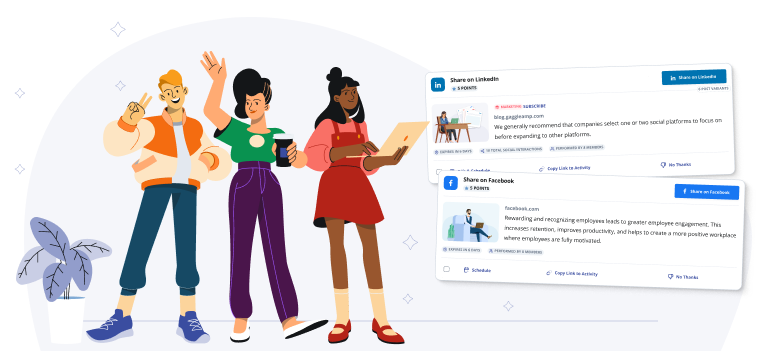
- Supply ready-to-share content. Give people posts they can share in their own voice without starting from nothing. This is where AI quietly earns its keep: it clears the blank-page barrier, so a busy employee shares in a few seconds instead of closing the tab and meaning to get to it later.
- Recognize early participation. A quick public shout-out for someone who is showing up costs you nothing and does more than you would expect. Just make sure recognition rewards real activity rather than trying to manufacture it.
Look at what those three moves share: every one of them widens participation. This is exactly where a per-seat tool works against you, because every new advocate you bring in shows up as a bigger bill. Broad participation is the whole point of advocacy, so the smart rollout invites everyone in rather than rationing who gets a seat.
This is also the month where content supply needs to become a system instead of a weekly scramble. Schedule posts ahead so you never hit a dry stretch, keep a healthy mix of brand, third-party, and employee-voice content in the queue, and lean on ready-made drafts for the folks who would otherwise stay silent. When there is always something worth sharing, people keep coming back.
How do you measure and expand after day 60?
The last stretch is where activity turns into proof, and proof turns into your next move. Here is the catch that trips people up: you cannot show a lift you never baselined. So even though the numbers do not matter until now, the measurement plan belongs in week one.
- Set a baseline before launch. Write down where your reach and engagement sit before anyone shares a thing. Without that starting line, the results you post later are just numbers with nothing to compare them to.
- Benchmark adoption. Hold your active-member rate up against the 65 to 85% that strong programs reach. A healthy number tells you the design is working. A low one tells you exactly where to dig in.
- Run a first results review. Take the numbers to the people who care about them and tie the program to an outcome you already track, whether that is web traffic, event signups, or leads. Showing the connection early is what earns the program its next round of support.
- Find your champions and plan the next group. The people sharing the most are your leaders for the next team or use case. Bringing in that next group is how a launch turns into a habit that lasts.
Why now: personal voices are winning
The timing is genuinely on your side right now. LinkedIn increasingly hands reach to personal voices over company pages, and the content your employees post is becoming raw material for AI search tools. LinkedIn is now the 2nd most-cited domain across ChatGPT Search, Google AI Mode, and Perplexity.
A brand whose employees stay quiet is getting harder to find in the exact places buyers now look first. So a rollout that gets your people active is not only a marketing win. It is how your company stays visible at all.
The one thing that carries all three phases
Strip everything back and it all rests on one idea: design for adoption from day zero. Build sharing into the tools people already open, recruit through the people they already trust, hand them content so nobody starts cold, and measure against a baseline you set on purpose. Do that, and the program does not fade a month after launch. It builds on itself.
None of this has to start from a blank page. GaggleAMP gives you the support to lean on when you need it. You follow a process that already works instead of inventing one, so you step firmly from day one.